UBJ Staff • August 19, 2026

PCR Business Finance Opens New South Los Angeles Headquarters
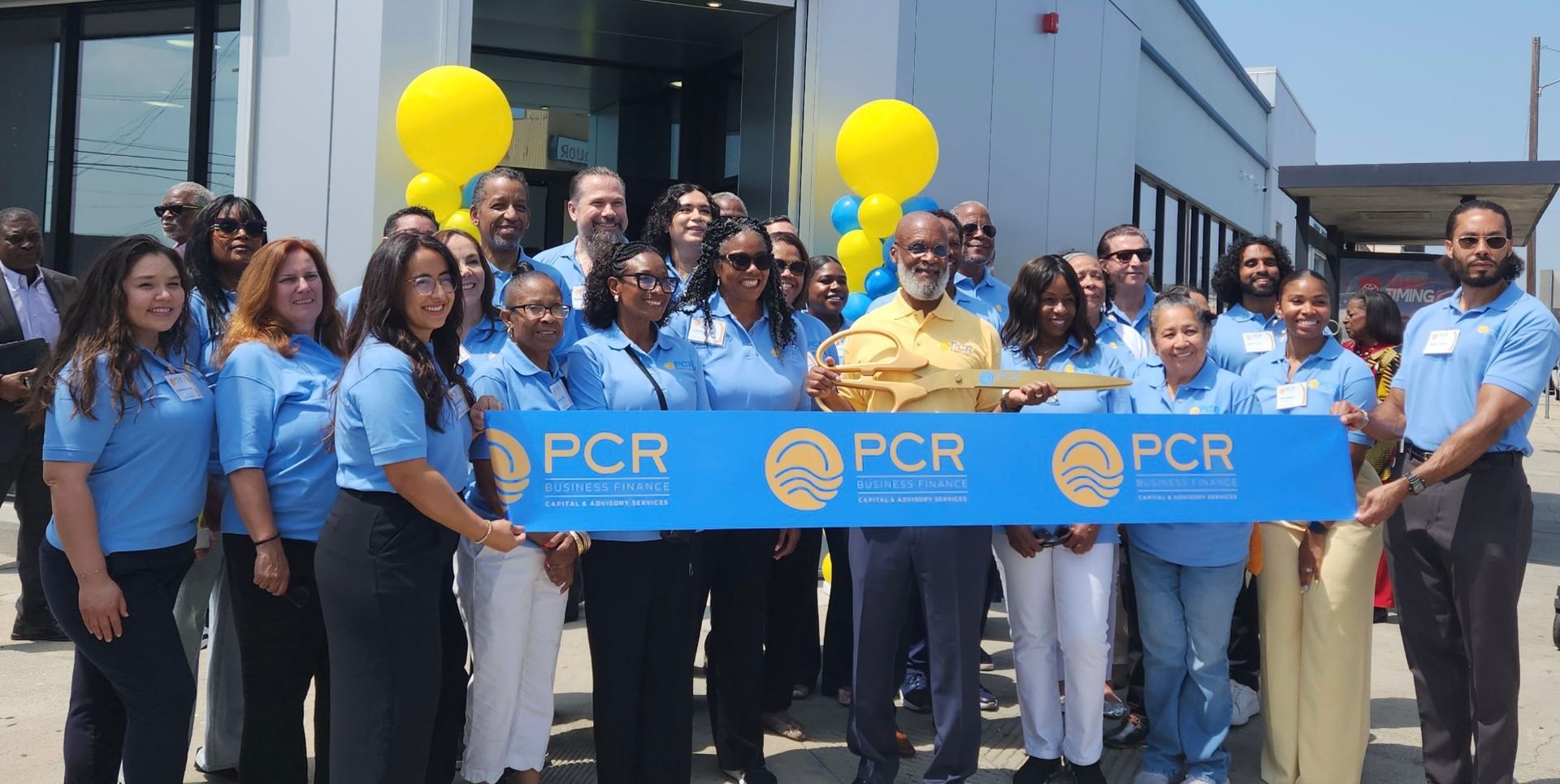
PCR Business Finance has officially opened the doors to its new headquarters at 3800 W. Slauson Avenue in Los Angeles, placing a major small-business resource directly in the community it was created to serve.

Elected officials, community organizations, business owners and supporters gathered for a ribbon-cutting ceremony and open house celebrating the new location—and what it could mean for entrepreneurs throughout South Los Angeles.

For PCR President and CEO Mark Robertson Sr., reaching this milestone required faith, determination and a clear commitment to the community.

“The process has been one of faith, persistence, pushing forward to make sure this happens for our community at this time,” Robertson said.

“PCR was started almost 50 years ago to support businesses that don’t have resources, and now, here we are, putting our footprint in the community that needs us most,” he continued. “We are just so excited about that.”

Nearly 50 Years of Expanding Economic Opportunity


Founded in 1977, PCR Business Finance is a nonprofit 501(c)(3) organization that promotes community economic development through financial, educational and advisory services.

PCR is described as the only organization in Los Angeles County with dual designation as both a Community Development Financial Institution and Small Business Development Center. Through those roles, the organization connects under-resourced entrepreneurs with financing, technical assistance, education and guidance designed to help them start, stabilize and grow their businesses.

Its new Slauson Avenue headquarters represents a significant investment in that mission—and in the future of South Los Angeles business owners.

“We’re not just celebrating today a new building, but what this building represents for South L.A. entrepreneurs,” said Los Angeles County Supervisor Holly Mitchell, who delivered the keynote address. “We deserve a world-class resource right here in our own community.”

Mitchell described the new headquarters as a $6 million investment in the unincorporated Second District and emphasized the importance of strengthening community-based financial institutions.


“We are here at a pivotal time,” Mitchell said. “Community development financial institutions are under attack from our very own federal government.”

“This $6 million investment—I said, $6 million investment—in unincorporated Second District really is a declaration that we believe in ourselves, this community, and we’re not going to wait on the federal government to validate our worth.”

A Visible Home for Business-Building Resources


Los Angeles City Council President
Marqueece Harris-Dawson celebrated PCR’s decision to make its presence visible along the Slauson Avenue corridor.

“A big round of applause for beautifying an already beautiful corridor—our corridor—and putting your name on front street so everybody can see that we’re up in here, about the business of our community having small businesses,” Harris-Dawson said.

“It’s important that you’re here. It’s important that everybody knows, if I ever get ready to have a business, I know where to go. It’s right here on the corner.”

Other officials and representatives attending the celebration included:

  • Long Beach City Councilwoman Tunua Thrash-Ntuk
  • Representatives from the office of Compton Mayor Emma Sharif
  • Representatives from the office of U.S. Rep. Sydney Kamlager-Dove
  • Representatives from the office of California State Sen. Lola Smallwood-Cuevas
  • Representatives from the office of California State Treasurer Fiona Ma
  • Representatives from the office of Assemblymember Isaac Bryan
  • Representatives from the office of Assemblymember Tina McKinnor
  • Representatives from the office of Los Angeles County Assessor Jeffrey Prang
  • Representatives from the office of Los Angeles Metro Board Director Jacquelyn Dupont-Walker

Helping Businesses Prepare for Major Opportunities


PCR enters its next chapter with a long record of connecting businesses and communities to capital.

The organization recently surpassed $50 million in administered funds through Los Angeles Metro’s Business Interruption Fund, one of many milestones it has achieved during nearly five decades of service.


PCR is also helping small businesses prepare for the economic activity expected around the 2028 Olympic and Paralympic Games in Los Angeles and other large-scale events coming to the region.


Those opportunities could generate new customers, contracts and visibility for local companies. But small-business owners may need financing, certifications, stronger operations and technical guidance to compete effectively. PCR’s combination of capital and business-development services positions the organization to help entrepreneurs become ready for those opportunities.

Bringing the Work Back Home


The opening also carried deep personal meaning for Robertson, who grew up in the surrounding neighborhood.

“It feels wonderful,” Robertson said after cutting the ribbon. “This is the community I grew up in. I went to 54th Street School, maybe just a half mile from here.”


“This is my neighborhood, and it’s good to be able to go out, have been educated, trained and bring all of that back to the community I love.”


With its new headquarters now open, PCR Business Finance is creating a visible place where entrepreneurs can seek funding, receive guidance and find the support needed to move their businesses forward.


For more information about PCR’s financing, education and business-advisory services, visit pcrcorp.org.


UBJ Takeaway: South Los Angeles and Southern California entrepreneurs seeking capital or business assistance should review PCR’s available loan programs, advising services and upcoming training opportunities—particularly those preparing for public contracting and LA28-related growth.


By Kim Anthony • September 25, 2026
Beginning January 1, 2027, California sales and use tax will generally apply to prewritten software delivered electronically or accessed remotely, including many Software-as-a-Service subscriptions. CALIFORNIA — If your business sells software, provides access to an online platform or pays for software subscriptions, a tax change belongs on your 2027 planning list. Under Senate Bill 122 , signed into law June 29, 2026, California is expanding the sales and use tax definition of tangible personal property to include certain digital products and associated copyright or patent interests. That means retail sales of covered products in California—and covered products purchased from a retailer for storage, use or other consumption in California—may be taxable beginning January 1, 2027 . The change generally affects sellers of prewritten software, SaaS providers, businesses that license or provide remote access to prewritten software, and the customers who buy those products. What counts as a digital product? For this law, a digital product is prewritten computer software delivered on physical storage media, transferred electronically or accessed remotely. Prewritten software is software held for general or repeated sale or lease. It can qualify even if it was originally developed for a particular customer or for a company’s own use. A combination of two or more prewritten programs can also qualify. What is outside this definition? The law does not classify every digital purchase as a taxable digital product. The following are excluded from its digital product definition: Digital assets, such as cryptocurrency Digital audio works, such as music, spoken recordings and ringtones Digital audiovisual works, such as movies and videos with sound Digital books, or eBooks Digital infrastructure, such as cloud platforms customers use to create, deploy or run their own software applications Digital video game products Digital visual works, such as computer-generated artwork The law also provides exemptions for custom computer software , digital products representing a service other than SaaS, digital products transferred with reproduction and distribution rights, and digital products purchased solely for use outside California. Businesses should review the details of a transaction before treating it as excluded or exempt. A $5 million rule for certain large purchases In some transactions, responsibility for paying the tax can shift from the retailer to the purchaser. The rule concerns a retailer’s aggregate gross receipts from digital products sold to the same purchaser that are transferred electronically or accessed remotely. For 2027 , the threshold is more than $5 million in that calendar year . Beginning January 1, 2028 , the test looks at whether those receipts exceeded $5 million in the current or preceding calendar year. When the rule applies, the purchaser may need a Use Tax Direct Payment Permit and may have to report and pay the tax directly to the California Department of Tax and Fee Administration (CDTFA). Location matters for local taxes For digital products transferred electronically or accessed remotely, the place of sale for local and district tax reporting is generally the customer’s address. The place of use is where the person accessing the product is located. That distinction matters when a company’s billing address and its software users are in different places. CDTFA explains the rules in its Tax Guide for Retailers and Purchasers of Digital Products . What sellers need to do California digital product sellers that are not already registered with CDTFA may need to obtain a seller’s permit , file sales and use tax returns, and report and pay tax on taxable retail sales. Out-of-state sellers that are engaged in business in California under Revenue and Taxation Code section 6203 may need a Certificate of Registration—Use Tax . They would collect and report use tax on covered sales to California consumers and pay it to CDTFA. Registration is available through CDTFA Online Services . The UBJ takeaway: Software sellers can use the months before January 2027 to review their products, customer locations, invoicing and registration needs. Buyers can review their software agreements and ask vendors how the new tax will appear on invoices. For the definitions, exemptions and reporting rules, start with CDTFA’s digital products tax guide
By Kim Anthony • September 24, 2026
Beverly Kuykendall helps businesses navigate complex markets, build stronger partnerships and turn ambitious ideas into workable plans. Some business leaders see a procurement requirement and stop at the obstacle. Beverly Kuykendall asks what it would take to move forward. Over decades in federal acquisition and commercialization, Kuykendall has helped organizations work through the demands of government contracting while keeping their commercial goals in view. Her career has included executive roles as President of Government Business, Chief Strategy Officer and President. In each, she has worked at the point where strategy must become something a team can actually execute. Today, Kuykendall advises mission-driven organizations and manufacturers seeking new routes to growth. For companies pursuing domestic production, that may mean beginning with practical steps such as packaging, labeling, kitting, light assembly or fulfillment. These staged solutions can help a manufacturer establish domestic capacity and enter a market while building toward a larger goal. She also helps manufacturers develop reseller and distribution programs with clear standards for selecting partners, onboarding them and measuring performance. The aim is to grow revenue while protecting the relationships and reputation a business has worked hard to build. Kuykendall’s strength lies in making complicated systems understandable and actionable. She sees how procurement rules, supply chains and commercial partnerships fit together—and where an organization can make its next move with confidence. For entrepreneurs and business leaders trying to enter a demanding market, that perspective matters. A complex path can still be a path. Kuykendall’s work helps organizations find it, prepare for it and take the next step.
By Kim Anthony • September 24, 2026
Felecia Fisher-Shamu has built a women-owned furniture manufacturing business whose work reaches from Los Angeles hotels to destinations around the world. Before Felecia Fisher-Shamu’s work appeared in luxury hotels and major entertainment venues, she was building relationships with the people who knew those spaces best: hotel engineering and housekeeping teams in Santa Monica and Los Angeles. She listened, learned what the work demanded and built a business around delivering it well. Today, Fisher-Shamu is CEO and co-founder of Vitality Casegoods, Restorations, and Furniture Manufacturing, Inc. In a competitive industry where women business owners have had to establish their place, she has earned a reputation for custom furnishings, furniture design and restoration. She has done it with creative vision, perseverance and a team of skilled craftspeople. Vitality’s work has reached properties in the United States, Anguilla, Saudi Arabia and Canada. Fisher-Shamu has contributed to sustainable projects with Google and ARIA in Las Vegas, as well as furnishings for major hotels and entertainment spaces. Her team’s work has also supported events associated with the NAACP Image Awards, the Daytime Emmys and Oscar celebrations, including a VIP gala honoring Black Panther costume designer Ruth E. Carter. Her passion for restoration gives the business another dimension. Vitality helped restore antiques from Paris for Lumière at the refurbished Fairmont Century Plaza in Los Angeles. Earlier in her career, Fisher-Shamu restored antiques for the Four Seasons Hotel Beverly Hills. She values the artistry in preserving a piece’s character as much as the skill required to create something new. Even during the pandemic, when the hospitality industry faced extraordinary disruption, Vitality continued to win work. Projects included SoFi Stadium’s Owners Club, Loews St. Louis Live! hotel and Circa Resort & Casino in Las Vegas. Fisher-Shamu’s story celebrates what a woman-owned business can build through talent, trusted relationships and the determination to keep going. Her furnishings may be found in celebrated spaces, but the deeper achievement is the enterprise she and her team have crafted along the way.
Show More